Sunday, May 29, 2011

Change is constant

Photo credit: lululemon athletica/ Flickr Creative Commons
I was waiting for a bus the other day after a teacher training workshop when a woman came out of a nearby tattoo parlor. As she walked by me, I caught a glimpse of her brand new tattoo: change is constant. This isn't a new concept to me - I've written about impermanence here before, for example (follow the tag on this post) - but for whatever reason, I received the message in a new way. It was as though there were a footnote on her tattoo that said: and that means you, too.

Change is constant and that means you, too. Sometimes I have this crazy fear that I can't change, that I'll always be fighting the same battles and making the same mistakes, that I'll always be stuck in the same patterns of being. In fact, change is inevitable, and that means me, too. Everything changes. And that conviction that we're in some way an exception, that our identity is somehow permanent and unchanging? Well, what are the chances of that?

This is pretty liberating and empowering - because change may be imperceptibly slow sometimes, but it is constant. On a cellular level, we're changing all the time as new cells die and are replaced; we don't usually notice those changes happening, but they are. Perhaps in a similar way, elements of old mental/ emotional patterns die and are replaced regularly, and although we can't see the changes taking place most of the time, we aren't stuck: we have an incredible capacity for transformation. This is our birthright. It is constant and inevitable. It's important, therefore, to work for positive change - because change will happen regardless. Look within and make those changes count! Namaste.

Monday, April 18, 2011

The wisdom I once knew

Yoga teacher training is giving me lots that I want to write about - and no time to write in. I hope these posts that are rattling around in my head will eventually make it here. Some of the things I've been learning seem new; other ideas are realizations that I've been reaching towards for some time but have only just found within my grasp. Still other ideas seem like things I knew once but thought I had forgotten.
Photo Credit: Tela Chhe/ Flickr Creative Commons
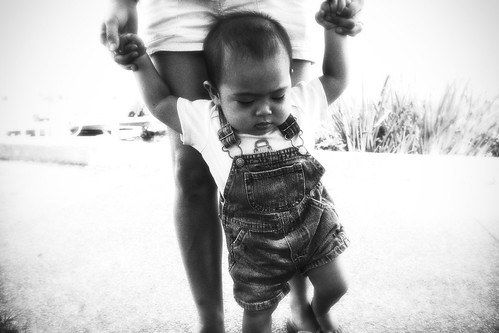
We all learned to walk once. From our positions on the floor, we were driven to grasp nearby objects and pull ourselves upright. In that position, we had to use our muscles in new ways, figuring out how to stabilize joints and stack our bones. Even then, with some measure of stability, we weren't satisfied. We had to walk, and then run - learning to keep it all together and balance in a constantly shifting world. We moved too fast, leaned too far, and fell - often, and sometimes painfully. We howled when we hit our heads on the corners of tables and scraped our hands and knees - but the next opportunity, we pulled ourselves upright and ran headlong into the next disaster, fearless, until we learned to feel our own center of balance and remain steady on our feet.
Photo Credit: Neeta Lind/ Flickr Creative Commons
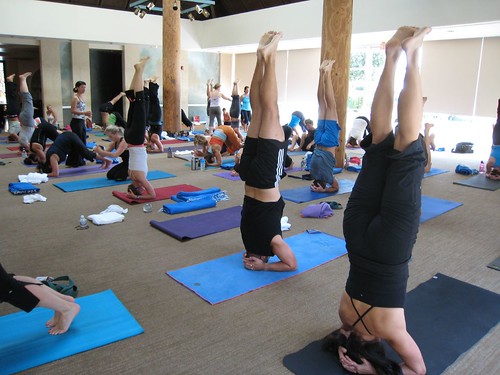
Now, many years later, most of us don't remember how we learned to walk. We're blissfully unaware of the painful headlong falls, and we have no conscious memory of how we learned to balance on our feet. When it comes to balancing upside down - on your head or hands or forearms - it may seem like something completely new. As I try to understand the limits of my balance in inversions, however, I'm realizing that I have done this all before. I've already been through this process of challenging the force of gravity, of learning to stack all the bones in my body on top of each other, of finding the point of lightness and effortless balance in a seemingly impossible vertical position. Somewhere, in those deep hidden places in the body where forgotten memories go, I know how to learn this.

Back then, those hurtling falls didn't faze me for long. Now, when I reach too far with my legs and come crashing to the ground, I'm left with a lingering fear that sends me back to basics, just trying to straighten my legs into the air again. Somewhere deep inside, I need to connect with the toddler me - that little girl who wanted so badly to walk around, who had such incredible confidence to try again, who had not yet learned to dwell on past failures. In my practice, I'm seeking the simplicity of being of a child. I'm striving to bring in a little innocence to balance my wisdom, to infuse beginner's mind into these poses. I want to do them with all the knowledge I've gained from my previous attempts, but also with the openness that comes with trying something for the first time.

Surely part of the practice is to walk, run, dance, balance on your head, and love as though you've never been hurt, never fallen down, never cracked your head against the corner of a table. To be fully present through the falling and the getting back up, and then to be fully present in the next attempt - as though falling last time had nothing to do with what will happen this time - because it doesn't, in fact, as hard as that is to believe. Maybe that's all of the practice in fact, all the work there really is to do. I'm starting to think that it will be enough.

Tuesday, March 22, 2011

OK, Rumi, let's dance.

Photo Credit: Jean-Pierre Dalbera/ Flickr Creative Commons
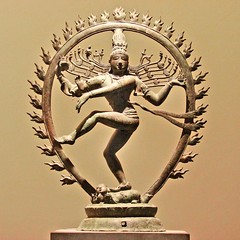
We're fools whether we dance or not, so we might as well dance.
~Japanese proverb

Let the beauty you love be what you do. There are a thousand ways to kneel and kiss the earth.
~ Rumi

Nathan over at Dangerous Harvests just made his second anniversary post. Happy blogiversary, Nathan! To celebrate, he posted his first post from the blog. It isn't my anniversary, but I thought I'd go back and look at my first post anyway. Here's a piece of it (from November 2, 2008):
If yogis discovered the secret of happiness thousands of years ago, why do we now still live in a culture of so much suffering?! And to put it more personally, since this is to be my personal journey, why do I still suffer so much? Why do I forget to practice in my daily life, when I know that it will not only make me happier and healthier, but also decrease suffering in the lives of those around me?

In June, I started a Masters in International Education at the SIT Graduate Institute in Vermont. I chose the school because I believe the SIT philosophy is highly compatible with my attempts to increase the practice of yoga in my daily life. In formulating my learning plan, I stated as my second learning objective "Explore ways to bring my career into harmony with my yoga practice." In fact, this is one of the key reasons why I am doing this degree - to give myself the training and the tools to adjust my working life to facilitate my practice - and yes, cheesy cheesy, to do more good in the world.

It's interesting to look back on because I don't feel that way any more. It's not that I don't suffer, but that the quality of my suffering has changed. Back then, I was suffering in the dark. Now, I feel like I can at least suffer with the light on. I have a consistent daily practice, not only of yoga and meditation on the mat or cushion, but also taking these practices into my life and applying them to running, eating, working, and personal relationships. Through this, I've not only physically transformed but I've begun to shine the flashlight of mindfulness into all sorts of dark corners.

In the beginning, this blog was about bringing my career into alignment with my yoga practice. I had forgotten that. Back then, I was working a challenging administrative job and struggling to practice yoga in the workplace. I was reluctant to admit that I was struggling so much because it wasn't the right place for me to be. It was a job that worked with my strengths and which brought out all the worst in me, too. I suffered in many ways at that time: emotionally, physically, mentally, spiritually. The suffering had to get really bad before I was really willing to look at the forces that were holding me there and ask myself: Why? Why fight? Why not just let go?


I was clearly looking for the light switch, even then. I'd started my Masters program because I was already seeking. I wrote those things in my learning plan and started this blog for a good reason. I've even had a Rumi quote up on my computer sidebar, probably since before I started this blog: Let the beauty you love be what you do. It took me all this time to really see it, to look Rumi in the eyes and reply, Yes. OK. I know why you are here. Let's dance.

When I started shining that flashlight around, mostly what I saw was fear. When I looked more closely, I realized that fear is always worse than the thing I fear.  I know this is not a new concept, but the more I sit on my cushion in silence with my eyes closed, the more I have to make friends with it. I began to wonder if I ever had any other motivation for action in my life besides avoiding fear. I began to wonder what would happen if I did something for love. Would the world end? Would the boogieman in the corner come out and get me? Did it matter?

There's never any map for these journeys we take, or rather, I'd say there are many maps - the experiences of others who have taken their own journeys and lived to tell the tale - but they're cryptic and incomplete, and sometimes we flat out refuse to believe that they could really be telling us to leap off that cliff into the darkness. Over the past three years, I've been evolving. I feel like the same person, but when I look back to that first post, I know I am not. I'm teaching at Community College now, and it's scary and difficult and fulfilling. I just started Yoga Teacher Training this past weekend. I'm finally ready to take the necessary risks in order to make sure all the pieces of my life really fit. I've learned to feel gratitude for the fear and suffering, because I've realized that they were the map and directions. They were the flashlight. I'm ready, finally, to really love what I do.