Showing posts with label alignment. Show all posts

Monday, April 18, 2011

The wisdom I once knew

Yoga teacher training is giving me lots that I want to write about - and no time to write in. I hope these posts that are rattling around in my head will eventually make it here. Some of the things I've been learning seem new; other ideas are realizations that I've been reaching towards for some time but have only just found within my grasp. Still other ideas seem like things I knew once but thought I had forgotten.
Photo Credit: Tela Chhe/ Flickr Creative Commons
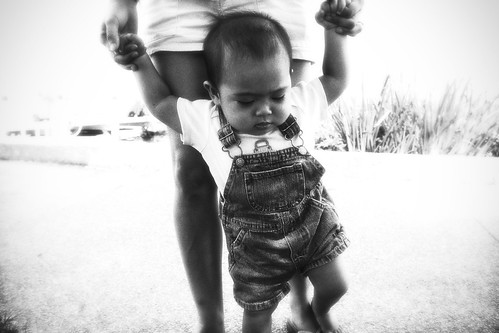
We all learned to walk once. From our positions on the floor, we were driven to grasp nearby objects and pull ourselves upright. In that position, we had to use our muscles in new ways, figuring out how to stabilize joints and stack our bones. Even then, with some measure of stability, we weren't satisfied. We had to walk, and then run - learning to keep it all together and balance in a constantly shifting world. We moved too fast, leaned too far, and fell - often, and sometimes painfully. We howled when we hit our heads on the corners of tables and scraped our hands and knees - but the next opportunity, we pulled ourselves upright and ran headlong into the next disaster, fearless, until we learned to feel our own center of balance and remain steady on our feet.
Photo Credit: Neeta Lind/ Flickr Creative Commons
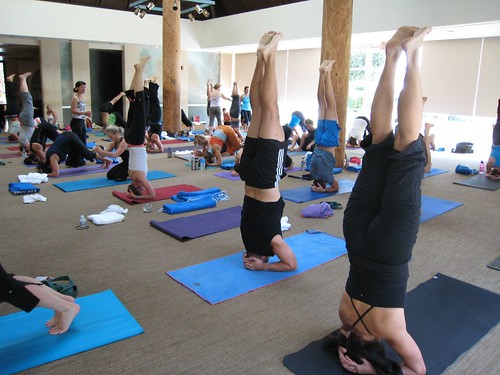
Now, many years later, most of us don't remember how we learned to walk. We're blissfully unaware of the painful headlong falls, and we have no conscious memory of how we learned to balance on our feet. When it comes to balancing upside down - on your head or hands or forearms - it may seem like something completely new. As I try to understand the limits of my balance in inversions, however, I'm realizing that I have done this all before. I've already been through this process of challenging the force of gravity, of learning to stack all the bones in my body on top of each other, of finding the point of lightness and effortless balance in a seemingly impossible vertical position. Somewhere, in those deep hidden places in the body where forgotten memories go, I know how to learn this.

Back then, those hurtling falls didn't faze me for long. Now, when I reach too far with my legs and come crashing to the ground, I'm left with a lingering fear that sends me back to basics, just trying to straighten my legs into the air again. Somewhere deep inside, I need to connect with the toddler me - that little girl who wanted so badly to walk around, who had such incredible confidence to try again, who had not yet learned to dwell on past failures. In my practice, I'm seeking the simplicity of being of a child. I'm striving to bring in a little innocence to balance my wisdom, to infuse beginner's mind into these poses. I want to do them with all the knowledge I've gained from my previous attempts, but also with the openness that comes with trying something for the first time.

Surely part of the practice is to walk, run, dance, balance on your head, and love as though you've never been hurt, never fallen down, never cracked your head against the corner of a table. To be fully present through the falling and the getting back up, and then to be fully present in the next attempt - as though falling last time had nothing to do with what will happen this time - because it doesn't, in fact, as hard as that is to believe. Maybe that's all of the practice in fact, all the work there really is to do. I'm starting to think that it will be enough.

Thursday, February 10, 2011

Chain reaction: Continuing to focus back

Photo credit: Soham Basoham (soham_pablo/ Flickr Creative Commons)
I have a confession to make.  For the first time in my life, I've had terrible back pain since some time last month. As a yogi, I couldn't help thinking This shouldn't be happening to me. I kept hoping it would just stop, but it didn't. In fact, as you might have guessed, it got worse until it was really affecting my quality of life and severely impeding my ability to sit in meditation. I couldn't figure out what was triggering it. I'd been traveling a lot during December and the first part of January, and the pain started some time after I returned home. I feared it was my return to running after taking some time off, or maybe it was my bed? I did more yoga, hoping I could work out the kinks, but my back continued to get worse. I deepened my inquiry into the back body. And then, I wrote my last blog post.

After reading my post, Kit Spahr, who blogs at Sometimes It's Art, wrote to tell me she's been engaged in a similar exploration of the back body. She turned me on to this post by Katy Bowman. I tried the suggested exercise and discovered, of course, that I'm a rib thruster. Katy provides some useful tips for correcting this alignment problem, and I started to consider these.

Then I started catching up on my Yoga Journals that had come around the holidays when I'd been too busy to read them. In the December 2010 magazine, the Anatomy column is by Roger Cole and is called "Easy Seat" (unfortunately not available online, but if you have the magazine, it starts on pg. 75). Cole talks about contracting the lower erector spinae muscles to correct misalignment and eliminate back pain in Baddha Konasana (Bound Angle Pose). When I read it, I had a sudden realization. Far from keeping my back healthy, my yoga was causing my back pain - and it had been exacerbated to its current level by poor alignment in seated meditation during my Commit to Sit program.

The next time I sat, I was able to follow the whole chain reaction in my spine. My hamstrings are tight from running, so it's hard for me to achieve the correct pelvic position in a crosslegged seated position (the top of my pelvis is tilted back). I've been adjusting for this by sitting up on blankets or a meditation cushion, which allows me me to tilt my pelvic into a neutral position, but it takes effort to hold it there so as I focus on relaxation or on the breath, I tend to slip and round the lower back again.

Very often in yoga class, an instruction is given in a crosslegged seated pose to "roll the shoulders up, back, and down." When I was less flexible in the upper body, this had the intended result of opening my chest and relaxing the shoulders down, but as my chest, back and shoulders became more flexible and my shoulder blades became more mobile, I began performing this action by thrusting my thoracic spine far forward and pushing the shoulder blades deep into the back.

Another common instruction is to "lift the chest/ sternum" (I mentioned this in my last post), which I achieved by thrusting my ribs forward. Add this to my sometimes rounded lumbar spine, and I've been putting a huge amount of stress on my thoracic spine to curve in ways it was never meant to. (Cole's article is really excellent and has a helpful way to explore the curves of the spine and the use of the erector spinae muscles using cat/ cow which I highly recommend.)

One way I can tell when I'm doing this is that belly breathing is difficult, even painful. For years, I've been having occasional difficulty with the three-part yogic breath; I now realize it is often hard when sitting but always easy when lying on my back. I'm not sure of the anatomical explanation for this, but sitting the way I have been (slightly rounding my lumbar spine and pushing the thoracic spine forward to compensate while thrusting the lower ribs out), breathing into the belly is painful. When I contract the muscles along the lumbar spine and pull my lower ribs back while focusing on flattening my shoulder blades onto the back instead of thrusting them into the back, I can suddenly breathe into the belly with ease.

Another instruction I've misunderstood is one often given in seated forward bends: lead with your chest. The idea of this instruction is to have students bend at the hips instead of rounding the spine to get further down. However, because I don't have the mobility in my pelvis but I do have a lot of flexibility in my upper back, I realize that I've been backbending in my forward bends, thrusting the chest way out and the ribs way forward. Focusing on keeping the lower ribs in as Cole describes in his article allows me to work on bending forward from the pelvis instead of pushing the chest forward.

I guess part of the problem is that instructions that were appropriate for me as an asana beginner became harmful to me as I developed more flexibility in my upper body while remaining relatively tight in my lower body. I had a complete misunderstanding of how good spinal alignment should feel in my body and had no idea that I was having any of these problems until my back started hurting. Now that I've recognized the problem, I can begin working to correct it but my muscles need to get used to working in these new ways and I get tired easily. My back is improving - but slowly. In the meantime, seated meditation is painful - unless I sit in Virasana, elevated on a block or cushion to protect my knees, in which case I can easily achieve the appropriate alignment of my pelvis (and therefore my back) and alleviate pain.

If you're a yoga teacher, do you give these types of instructions to your students? It might be useful to find out if any of them are having midback pain or struggling with belly breathing, and to explore whether this is a cause. Perhaps meditators with midback pain could benefit from the suggestion to try (modified) Virasana for meditation, as well as working on flexibility in the hamstrings and working with the alignment of the pelvis and thoracic spine. If anyone out there is having similar problems, I hope this helps you with your own exploration.
Saturday, February 5, 2011

Everything has another side

Me, as seen from the back
In truth, it matters less what we do in practice than how we do it and why we do it. The same posture, the same sequence, the same meditation with a different intention takes on an entirely new meaning and will have entirely different outcomes 
~ Donna Farhi


In October, I took a workshop at the Ojai Yoga Crib with Laura Tyree. First of all, if you can get to the Crib, go. It has changed my life and continues to do so every year that I attend. (I think it's been six years now.) For that matter, if you get a chance to practice with Laura, do. Her wisdom and compassion (not to mention her beautiful voice!) will take you somewhere deep inside yourself - and wherever that place is, it is where you need to be.

In the workshop I took last October, Laura talked about how issues with her heart led her to explore her downward facing dog and consider how achieving a backbend in that pose was putting pressure on the heart. In many of the popular hatha yoga styles here, we do a lot of downward dogs, so this is a much repeated problem for many practitioners. As we get more flexible, this causes us to sway our backs in the pose, creating this backbend. She showed us how she was exploring a lift through the back between the shoulder blades. We practiced with a partner, having the partner place her hand on our backs so we could feel where the lift was happening.

When my partner put her hand on my back, I knew that I would always be able to find the right place to lift because it was in the exact location where I've had chronic back pain for years - upper mid-back, right between the shoulder blades. In that moment, I realized I had better pay more attention to my down dogs. Over the past few months, that realization has broadened into another: I had forgotten about my back entirely!

I love bhakti yoga and huge back bends and opening my heart to the sky with absolute abandon. However, I have very tight hamstrings from years of running and I do not love forward bends quite so much. I'm not tortured by them as much as I used to be, but when I do them, I'm usually focused on what my front body is doing. (And probably trying to make the pain in my back body go away by ignoring it. In case you didn't know, this doesn't work.) Now, I am reminded that there are at least two sides to every issue - even me!

I've started focusing on my back body all the time, not just in downward facing dog. I've been doing chakra meditation on the back body instead of the front. (So often teachers neglect to describe the chakra locations in terms of the back body, so I suspect I'm not the only one who has this problem.) I've discovered that pain relief often comes from directing my breath there. I've discovered that I can breathe into my kidneys as well as my belly, and into the space between my shoulder blades as well as my chest. I've discovered that this adds support, both in seated meditation and asana, and sometimes results in shifts in postures that feel really good and even relieve pain. I'm starting to feel how my lumbar spine (lower back) is overextending to compensate for the way I'm drawing my thoracic spine inward to get that exalted open-hearted feeling. Opening my heart center forward is killing my back - who knew?

Yesterday, I was looking for something entirely different in Judith Lasater's Yoga Body book, and I came across the following passage:
"One of the unfortunate actions that sometimes happens in asana practice is an over-flattening of the natural kyphosis [normal curvature of the spine]. Students are sometimes taught to lift the sternum with the intention of opening the chest, and they do so by bringing their thoracic spine into the body, thus flattening the curve. After years of practice, the spine loses some of its natural curve."
Bingo - that's me. The book suggests standing on a yoga mat near a doorway and holding onto the doorway with your arms at chest level and hands crossed at the wrist. Then you walk backward slowly and round the thoracic spine upward while moving the shoulder blades apart and dropping your head between your arms, allowing some of the muscle tension in this area to be stretched and loosened. I will certainly be trying this in the future, and paying a lot more attention to how I support backbends with the breath from the back side of the body - not to mention focusing on how I may be collapsing here in forward bends and all sorts of other issues I've never considered before.

If I wanted to get philosophical here, I could explore the idea that the back represents my past, or talk about the side of anything that lies in shadow... but for once, I want to stay on the mat with this one. When I'm on the mat, I'm on the mat - both the front and the back sides of me. The more I practice asana, the more I realize there's always something I've forgotten to be present with in the pose; there's always a part of the body I've given preference to and another that's been lost from my conscious awareness. But the body has its own intelligence and if we know how to listen, it will let us know what has been forgotten. One thing is for sure: in the future, I'll be thinking a lot more about what those chronic achy bits are trying to tell me.

Thursday, January 22, 2009

Alignment

I know I have said before here that what happens on the mat is often a microcosm of what happens off the mat. I have been reminded of this connection again recently. Take, for example, the notion of alignment. If you are new to asana practice and you have a good teacher, you will probably hear her saying things that you don't understand or simply can't do. There may be nagging questions that recur every practice - "What does she mean, lift the palms?! I can't do that." "Spiral the inner thighs outward?" "Push into the feet and lift your hips towards the sky?! My hamstrings are screaming. What does he mean, push into the feet?" When you first start practicing, you may not be aware of your body and it can be hard to figure out whether everything is lined up correctly, and tension in the body can prevent the right alignment from occurring without modifications.

If you continue to practice with patience, one day something will be a little bit different. Perhaps you do a different sequence of poses to warm up, or maybe you practice at a different time of day, have been doing more yoga, or are simply ready. Alignment is one of those things in life that you might wonder if you're experiencing when you don't have it right, but when you get it, you know. It's also one of those feelings that can be very hard to put into words. When the
principles of alignment are applied correctly, energy flows freely through the body and you can find ease in the pose. The body feels both lighter and more grounded. The spirit is joyful.

I know I have written in
this blog about a teacher who talked about balancing the past and the future. His class focused on opposing forces: energy both rooting or grounding behind (into the past) and reaching forward (into the future). The grounding of energy allowed a lightness and freedom, allowing the forward energy to flow freely. It is important that this process does not involve clinging to the past or grasping for the future. The body remains balanced between opposing forces, firmly in the present.

Recently, I experienced this phenomenon off the mat. After months of struggling with life, experiencing the emotional equivalent of tight hamstrings, I had an encounter that left me with a very distinct sense of grounding into my past. As I considered this over the coming days, I suddenly experienced the sense of alignment, of my life path falling into place ~ and of a sudden freedom to reach into my future unrestrained. The sensation was very similar to that I have experienced when finding the right alignment in a pose - the same lightness of being, the sense of balance and grace. While both past and future are essential to this experience, the ultimate result has little to do with either ~ it is rather a sense of being completely present and in the right place.

I wonder if I had not been familiar with this experience on the mat, would I have recognized it off the mat? Would I have overly fixated on the past or the future and missed the opportunity to be fully aware of where I am?