
"Death is not the biggest fear we have; our biggest fear is taking the risk to be alive -- the risk to be alive and express what we really are."
-- Don Miguel Ruiz
"You gain strength, courage, and confidence by every experience in which you really stop to look fear in the face. You must do the thing which you think you cannot do."
-- Eleanor Roosevelt
Arm balances and
inversions are classic ways to work with the emotion of fear in hatha yoga. I've recently been re-visiting both after years of avoidance. These poses raise in me, as for many people, a sense of impossible challenge - both in terms of strength and skill. I was content with my sun salutations, but recently I've been encouraging myself to confront my fears and work on these postures. I've learned a lot in particular from
bakasana (crane pose) and
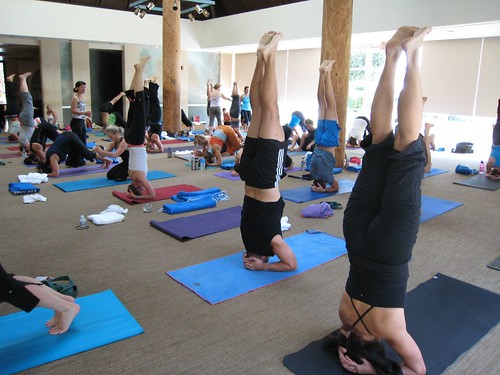
salamba sirsasana (headstand) in recent weeks. Both poses evoke fear in me - but that has come about in different ways for each pose - and in both poses I have recently begun to overcome my fear of falling.
I was introduced to bakasana several years ago by a teacher I liked and trusted. I had been pursuing a lot of gentle and restorative yoga during that period, which was helping me cope with a stressful job change. As I returned to more faster, flow-based asana, I discovered that I had built a lot of strength and flexibility working in the gentler traditions. When this teacher demonstrated bakasana, I believed her assertion that I could accomplish this pose. Like a child who has not yet learned that the world holds dangers, I went into the pose innocently and fearlessly. I soon lifted into the beginner variation of this pose, feet lifted but arms not yet straight, and I loved how it felt to balance there.
So where did my fear of this pose come from? In researching for this post, I found this about arm balances on
Mark Stephens' web page: "They involve fear and ego while bringing about self-confidence and humility." I was about to experience the ego and humility part of things. Eager to show off this new arm balance one day, I attempted it at home without warming up, went into it too quickly, held it briefly, and then crashed
hard onto the bridge of my nose. It hurt! I was wearing glasses at the time, which bent quite badly but luckily could be repaired. My ego and my innocent fearlessness, however, took more permanent damage and for the next two years or more I was unable to lift even one foot off the ground in this pose.
Headstand is different. Inversions terrify me (with the exception of shoulder stand, which I think I went into early enough in my practice that it didn't occur to me to be scared).
Of course I can't do that, I tell myself.
I'll fall and/or smash my head on the ground! Whenever headstand has come up in class, I've done the preparatory exercises, which were scary enough. Working with my fear in the preparatory poses was hard; it never occurred to me to actually try to kick up into the full pose.
Several weeks ago, I was practicing at home and I just kicked up into headstand at the wall. I have no idea what made me do it. There's no question that I had the ability to do this all along. I could tell that my alignment was good in the pose; my weight was in my arms, and I was comfortable there. All the fear just melted away, and since I've been able to continue working in the pose. It has done wonders for my self-confidence!
Bakasana is harder. I wonder if this is because my body has a painful memory to go along with the fear. I am just beginning to trust the strength of my arms again, my ability to know how the weight of my body should be distributed. It takes me a long time to find the courage, but I'm finally able to lift my feet off the ground again. I hope that one day I'll be able to straighten the arms.
I'm starting to recognize how often these two types of fear come up in other aspects of my life. Sometimes we're afraid that we'll fall (or fail) because of a previous experience; sometimes we're just afraid because of what lurks in our imagination. It's important to acknowledge that fear is a legitimate response to many things. After all, falling heavily on your head or neck is dangerous. Having your heart broken is devastating. Losing your job can put you in dire financial straits. The list goes on and on. But fear is so often paralyzing, and it can prevent us from experiencing our true potential, from continuing to learn and grow. We have to learn to assess our abilities and strength; to know when to go further; to have faith in our own resources and in those who support and encourage us; and to know what is and is not a serious consequence. Whether it's an inversion or love, the results of that trust can be exhilarating.
Let yourself take flight.
Namaste.


 Posts
Posts


